Showing posts with label Asia. Show all posts

Sunday, June 07, 2009

How to fight North Korea

Nicholas Guariglia writes:

"...start a serious reverse-propaganda program of beaming real information into North Korea, similar to Radio Free Europe at the end of the Cold War. We should weaken the tyrant’s rule from within; when done properly, it works almost every time. To paraphrase my friend Michael Ledeen: there are many ways to destroy a dictator when you have his oppressed people on your side."

Saturday, February 14, 2009

Force Recon Marines sent to the Philippines

"A company of Force Recon marines has been sent to Basilan to help with the search for the kidnappers of three UN workers. The Force Recon marines are highly trained, and would likely be used for the actual assault on the kidnappers camp."

This might actually be Filipino Marines. More at StrategyPage.

Thursday, September 06, 2007

The Hanoi Hilton

From John McCain's campaign website, video of the torture and solitary confinement he suffered as a Prisoner of War during Vietnam.


Regardless of what you think of his politics, it's powerful stuff.

Wednesday, August 29, 2007

Deserting Your Allies

Via Newsweek:

In Pakistan, President Musharraf was wary of his American allies in the War on Terror. In 2002, he told a high-ranking British official: "My great concern is that one day the United States is going to desert me. They always desert their friends." According to this official, who declined to be identified sharing a confidence, Musharraf cited the U.S. pullouts from Vietnam in the 1970s, Lebanon in the 1980s and Somalia in the 1990s.


Victor Davis Hanson picked up on this:
Note the recent quotes from Pakistani and Syrian strongmen to the effect that the U.S. abandons its friends. These are not right-wing talking points, but candid assessments by selfish, calculating dictators about the world as they saw it. Their referents, like bin Laden’s, are mostly Vietnam.


Who says Vietnam should not serve as a lesson to Americans about the disastrous consequences of abandoning its allies?

Friday, August 24, 2007

And What Will Happen If We Exit Iraq?

I quoted from this Webb essay back in February.

James Webb, circa 2000:

"...the aftermath of Saigon's fall is rarely dealt with at all. A gruesome holocaust took place in Cambodia, the likes of which had not been seen since World War II. Two million Vietnamese fled their country — usually by boat — with untold thousands losing their lives in the process. This was the first such diaspora in Vietnam's long and frequently tragic history. Inside Vietnam a million of the South's best young leaders were sent to re-education camps; more than 50,000 perished while imprisoned, and others remained captives for as long as 18 years. An apartheid system was put into place that punished those who had been loyal to the United States, as well as their families, in matters of education, employment and housing. The Soviet Union made Vietnam a client state until its own demise, pumping billions of dollars into the country and keeping extensive naval and air bases at Cam Ranh Bay.


Now James Webb, circa August, 26th, 2007, on ABC's This Week:

Moran: Senator Webb, you're a Vietnam veteran, won the Navy Cross there, and have made no secret over the years that you feel that America betrayed the Vietnamese people, and abandoned them to a cruel fate, isn't that what the president is saying here what will happen to the Iraqis if we withdraw?

Webb: Well, I think that I may be one of the few people in government who still on the one hand strongly believe in what we attempted to do in Vietnam, and on the other hand from the beginning have strongly warned against the strategic blunder of going into Iraq.

They simply are not comparable. If you look at even the opinions of the American people, despite the way that the Vietnam war ended, 8 years after the Gulf of Tonkin, in 1972, the American people by and large, in a 74 to 11 percent, still believed that it was important that South Vietnam not fall to communism.

The overall strategic objective was strong, the implementation became flawed.

In Iraq, we’re having a reverse situation. We have an overall strategic objective that was not directly related to what we were attempting to do in the war against international terrorism. We have good people implementing a bad strategy. It’s just not the same situation. … We’re not going to have stability in that region until the American troops are out of Iraq.

(Video here)

Not comparable? Hasn't Webb compared the two in the past? I see no sound rationale in his explanation that we can abandon the Iraqis now, but were wrong to do so to the Vietnamese then.

Judge for yourself whether Webb parsed his own words, or was just politicking. I think he sounds like a sophist.

More at Instapundit.

Sunday, July 29, 2007

Victory and Hope


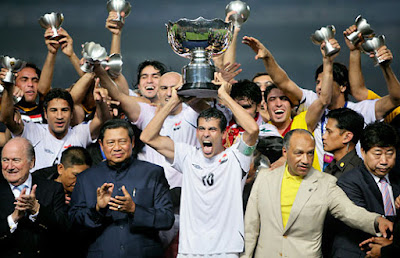
Iraq Wins the Asia Cup

The New York Times has The Celebration Across Iraq


More from Hot Air.

Tuesday, June 26, 2007

Purple Hearts In Excess

This post by Instapundit blew me away:

SOME PERSPECTIVE: I was reading some stuff on the plans for invading Japan at the end of World War II when I ran across this:

Nearly 500,000 Purple Heart medals were manufactured in anticipation of the casualties resulting from the invasion of Japan. To the present date, all the American military casualties of the sixty years following the end of World War II — including the Korean and Vietnam Wars — have not exceeded that number. In 2003, there were still 120,000 of these Purple Heart medals in stock. There are so many in surplus that combat units in Iraq and Afghanistan are able to keep Purple Hearts on-hand for immediate award to wounded soldiers on the field.

And at current rates we'll still be using them for decades. My grandfather fought all across Europe, then got shipped to the Pacific in preparation for invading Japan. He was extremely happy that the war ended without that being necessary.


As devastating the losses we suffered during World War II, how much worse it could have been.

Update: The plot thickens - Wikipedia:
Redeployment

See also: Orders of battle for Downfall

Olympic was to be mounted with resources already present in the Pacific, including the British Pacific Fleet, a Commonwealth formation that included at least a dozen aircraft carriers and several battleships. The Australian First Tactical Air Force took part in the Philippines campaign (1944-45)

These would likely have augmented U.S. close air support units over Japan. The only major re-deployment for Olympic was Tiger Force, a Commonwealth long range heavy bomber unit, made up of more than 20 squadrons, scheduled to betransferred from RAF Bomber Command in Europe to airbases on Okinawa.

If reinforcements had been needed for Olympic, they could have been provided from forces being assembled for Coronet, which would have needed the redeployment of substantial Allied forces from Europe, South Asia, Australasia, and elsewhere. These would have included the U.S. First Army (15 divisions) and the Eighth Air Force, which were in Europe. The redeployment was complicated by the simultaneous partial demobilization of the U.S. Army, which drastically reduced the divisions' combat effectiveness, by stripping them of their most experienced officers and men.


My grandfather belonged to the 9th Division of the U.S. First Army. After fighting across North Africa, the Mediterranean and Northern Europe, it is very likely his feet would have landed on the shores of mainland Japan in what undoubtedly would have been one of the bloodiest battles in American history.

Sunday, June 10, 2007

America has a fan club, after all


South Korea and Albania got in on the action this past week.
Every once and a while, we are reminded why we do what we do, and we're thanked for it.

Monday, June 04, 2007

Take a Deep Breath

Victor Davis Hanson:

What's really the untold story about the Vietnam experience... between 1971 and 1973, 1974, the Vietnamization program actually had worked, and with American air power and supply, there was a viable South Vietnamese government, which was included in the Paris peace talks, and Mr. Kissinger really did have an agreement that there would be a south Korea-like authoritarian government that would have a chance to evolve into something like Korea did today in the south, and it would be protected by the promise of American air power.

And Nixon more or less kept that promise until 1973, '74, until Watergate and the combination of cut off of aid stopped that, and when we decided we would not support it as we had Korea, it fell.

One of the biggest lies about Vietnam was that, well, 'Vietnam must not have been viable,' or it would have survived on its own - well, south Korea can't survive on its own today, that's just the nature of democracies in that part of the world, they need the support and the promises of support from the United States.

... I think everybody in America this memorial day should take a deep breath and look at Fallujah and Najaf and why we're there, and go back and look at Vietnam, because after 1975, look what happens - there was a million boat people, there was a half a million people executed and put into re-education camps, there was the soviet invasion of Afghanistan, there was the soviet inspired revolution in central America, there was the takeover of the American hostages, there was oil embargoes, and there was a terrible national crisis, debate, over that, and it all accrued from that disaster of withdrawing after all that sacrifice and losing Vietnam.

Saturday, May 26, 2007

Happy Memorial Day

Mount Suribachi

From Townhall.com:

Dogtags and pins placed by United States soldiers decorate a signboard at the United States Marine Corps Landing Memorial on top of Mount Suribachi, Iwo-Jima in this December 13, 2006 file photo, the site of a fierce battle between Japanese and United States forces for control of airfields on the island during World War II. Iwo Jima and its airfields were the prize the United States needed so that fighter planes could escort bombers all the way to Tokyo. The Japanese knew they had no hope of victory, but to delay the U.S. victory and attack on the mainland, they built miles of tunnels and bunkers across the island from which they could be dislodged only with flamethrowers, hand grenades and small arms. To match WITNESS-IWOJIMA/ REUTERS/Michael Caronna/Files (JAPAN)

Sunday, May 13, 2007

The Myth of Modern China

From City Journal: The Empire of Lies by Guy Sorman

Another sign of the desire for freedom, particularly worrisome to the authorities, is the explosion of peasant revolts in the Chinese countryside. The countryside is an immense universe, immutable and mysterious even for Chinese city dwellers, who go there only to honor the tombs of ancestors. Traveling to a village is like taking a journey in time; old China emerges, and modernity seemingly slips away. It also is to encounter China’s communication problem: peasants, unfamiliar with the national language, speak only in regional dialects—though television, the great linguistic and cultural leveler, is making the country more homogeneous by the day.


This is a good read. It seems the world has been dazzled by the economic powerhouse of a sliver of China. Upon closer inspection, China's economic dynamo, led by its rapidly industrializing cities, are but the tip of the iceberg. The vast majority of the ice below, represented by China's drastically poor country folk, remains submerged below.

Update: A friend living in Shanghai offered these thoughts when I sent him the article:
Nice article, its true that all of these things happened and that the government indulges greatly in economic performance rather than social welfare. Its sad, I've been to these villages before, its so disgusting and person nevertheless becomes grave. I although believe that it indeed is very hard to control a country of over 1.3 billion residents. Domestic corruption has crippled most of these villages that westerners will perhaps never have the interest of visiting. You should come over sometime, I'll take you around Shanghai and perhaps if u like take you to one of the nasty villages. Take care bud.

Monday, April 23, 2007

"A quiet corner of Parliament House"

John Howard, Prime Minister of Australia:

Why our troops must stay [excerpts]

In one sense, this quiet corner of Parliament House is a long way from conflicts in Iraq and Afghanistan. In another sense, it helps bring into focus much of what is at stake.

A hallmark of our free society is the ability to debate issues forcefully and to resolve inevitable differences peacefully. Our enemies in Iraq and Afghanistan see this as a sign of weakness. We know it is our greatest strength.

A tough road still lies ahead

I am not asking Australians to discount the enormous difficulties in Iraq or to change their views about the original decision. I am asking them to consider the situation we now face and the stakes involved.

What Iraq and her people need now is time, not a timetable. They seek our patience, not political positioning. They require our resolve, not our retreat.

The Long War

The long war against violent Islamic extremism goes on. It is a very different kind of war – a war without borders and with no clear frontlines; a war fought as much by our ideas and values as by our armies.

Terrorist cells are active today in between 30 and 40 countries plotting action based on a warped interpretation of Islam. Attacks have been planned in Australia.

Nor should we forget the essential lessons of 11 September 2001 – that failed states can quickly become havens and projecting grounds for global terror; and that terrorists can turn our openness and technological achievements against us to devastating strategic effect.

Patriots and Internationalists

There are about 3,300 Australian Defence Force personnel on operations overseas or undertaking security tasks in our maritime protection zone. They advance our nation's interests and ideals with great courage.

I regard them as our finest patriots and our finest internationalists.

Roughly 2000 Australians are part of operations today in Afghanistan and Iraq.

In Afghanistan, our largest contingent – the Reconstruction Task Force in Oruzgan Province which I visited last week – is working in partnership with the Dutch on the reconstruction and improvement of infrastructure. It has made excellent progress rebuilding schools, roads and bridges and training the local population to ensure the benefits remain into the future.

No Timetable for withdrawal

For the record, let me state clearly why I believe a timetable for premature withdrawal of coalition forces from Iraq would invite disastrous strategic and humanitarian consequences.

First, it would undercut the forces of moderation in Iraq at the precise moment when they have a chance – perhaps the last chance – to stabilise their country. Sectarian violence would escalate, with the Sunnis abandoning the unity government and parliament.

Second, it would lead to more widespread and extreme human rights abuses, more internally displaced Iraqi civilians and further outflow of refugees to neighbouring states.

Third, a precipitate withdrawal would give a green light to those looking to make Iraq a platform for global terror. With Al Qaeda and other extremists claiming withdrawal as a victory, this would likely inspire more terrorism outside Iraq, including in South East Asia.

Iraq is undeniably a frontline in the fight against international terrorism. The terrorists view it as such.

Fourth, it would further destabilise what is already the world's most unstable region, perhaps igniting a wider war in the Middle East. Any prospect of resolving the Israel-Palestine conflict would lie in tatters.

And fifth, it would be a crushing blow to America's global leadership, emboldening those who, like Osama Bin Laden, have argued all along that America is a "weak horse" on which no one should depend.

Security first

We recognise that in Iraq as well as in Afghanistan political progress and security are inextricably linked.

Labor seems to believe that Iraq can achieve reconciliation without security – essentially, that if the coalition leaves the Iraqis will sort out their differences.

Let's be clear. Labor supports setting a timetable for withdrawal from Iraq irrespective of the situation on the ground. It would pull out Australia's combat forces as soon as it can. And it opposes stepping up our effort to train the Iraqi Army – even though the Iraqi government, the US government, Tony Blair and the Baker-Hamilton report all agree that training is a critical priority.

Our position could not be more sharply different.

We believe that restoring security in Iraq is critical to creating the space and time Iraqis need to find a lasting political solution. This means that we are opposed to a precipitate withdrawal. It means we are opposed to setting timetables for withdrawal.

And it means we strongly support training – which is why the government has decided to step up our training effort.

We will be able to leave Iraq. But we cannot do so responsibly until we have some confidence that the Iraqi security forces are in a position to defend Iraq's democratically-elected government and the Iraqi people, whether from terrorists, insurgents or sectarian strife.

There might be few good alternatives in Iraq. But that does not absolve those of us in positions of political responsibility from facing up to the alternatives that exist.

The right thing to do

The question to be confronted now is this: what do we do to maximise the chances of future stability in Iraq?

That means supporting the Iraqis and our coalition partners in their security operations and continuing to strengthen the capacity of Iraq's security forces. Then, as Iraq moves forward, we can draw back.

I believe this course is in Australia's long-term national interest. And it happens to be the right thing to do.

Thursday, March 15, 2007

Lightning Over Sydney

From a few nights ago


Monday, March 12, 2007

al-Qaeda arrests

India News:

US-led coalition forces Wednesday detained 24 suspects in separate raids targeting the Al Qaeda network in Iraq, the US military reported.

Eight suspected terrorists reportedly involved in the 'coordination, movement and emplacement of vehicle-borne improvised explosive devices' used against Iraqi and coalition forces were detained in a raid in south Baghdad, an official statement said.

I haven't seen this reported in AP or Reuters... does India know something we don't know?

Wednesday, February 28, 2007

Muslim Newspapers speak out on Terror

United Press International:

The London-based al-Hayat commented on Sunday's attack on European tourists in Saudi Arabia, saying it broke a six-month "silence of terrorism" in the kingdom. The Saudi-financed daily said the "ugly crime," in which four people were killed, came in a new form and place. It's as if the terrorists want to send a message that terror will from now on target tourists, it added, noting that an extremist trend opposes the idea of foreign tourism in their county. The daily, distributed in many Arab capitals, suggested those who carried out the attack may have been "victims of a (religious) fatwa (decree) that allows the spilling of tourists' blood," and the perpetrators might not have been a terrorist group. It called on religious leaders to forbid attacking foreigners, saying the "voices of the clerics and scholars are still too low or non-existent, although they are influential." It stressed that such violence normally carries the name of religion, and fighting it starts in the mosques.

However, a commentator from UPI also declares:

U.S. allies and their opponents, American congressmen and terrorist leaders, professional politicians and ordinary people, journalists and generals are increasingly comparing the war in Iraq with Vietnam. They are all wrong. Iraq is not Vietnam. The situation in Iraq is much worse, and the majority of parallels with the Vietnam war do not apply.

I don't have much time, but these arguments are so simplistic, it's absurd:
It was not very difficult for the United States to leave Vietnam. South Vietnam lost, and North Vietnam won

In Vietnam, the sides were fighting for control over the country, whereas Iraq became a territory a long time ago.

The war in Iraq involves everyone. The Iraqis believe that it is a war of insurgents against the occupants; the West believes that it is the war of the coalition forces against the terrorists; a war between Arabs and Kurds; and a war between Kurds and Turkmen. It is also a Shiite-Sunni war, and Iraq is the main front of this war which is unfolding in the entire Muslim world from Lebanon to Pakistan.

His first mistake was comparing the two wars, because they are both so entirely different. Secondly, and finally, because it's late, he compares the multitude of players in Iraq as if Vietnam was a singles tennis match. Vietnam involved the North Vietnamese, South Vietnamese, the U.S., Chinese, Russians, French... just to name a few. And the implications - the spread of communism, shouldn't be so idly dismissed because the new threat of Islamic terror has emerged.

Friday, February 23, 2007

India makes a smart decision


India has banned the export to Iran of all material, equipment and technology which could contribute to Tehran's nuclear program, the government said Wednesday.

The restrictions bring India, a longtime Iranian ally, into compliance with the U.N. Security Council resolution passed in December that imposed limited sanctions on Tehran for its refusal to stop enriching uranium, which could be used to produce nuclear fuel or materials for a nuclear bomb.